
OpenAI launches GPT-6.1 Terra: faster, stronger computer use at half the price
On October 26, 2026, OpenAI announced GPT-6.1 Terra on X, pitching it as faster, more capable computer use at a lower price. Terra can read what is on the screen, take actions across apps and write more naturally, and it is built for the everyday tasks that fill a working day.
Sam Altman wrote that the model is strong in many areas, but what excites the team most is the new era of computer use it opens up.
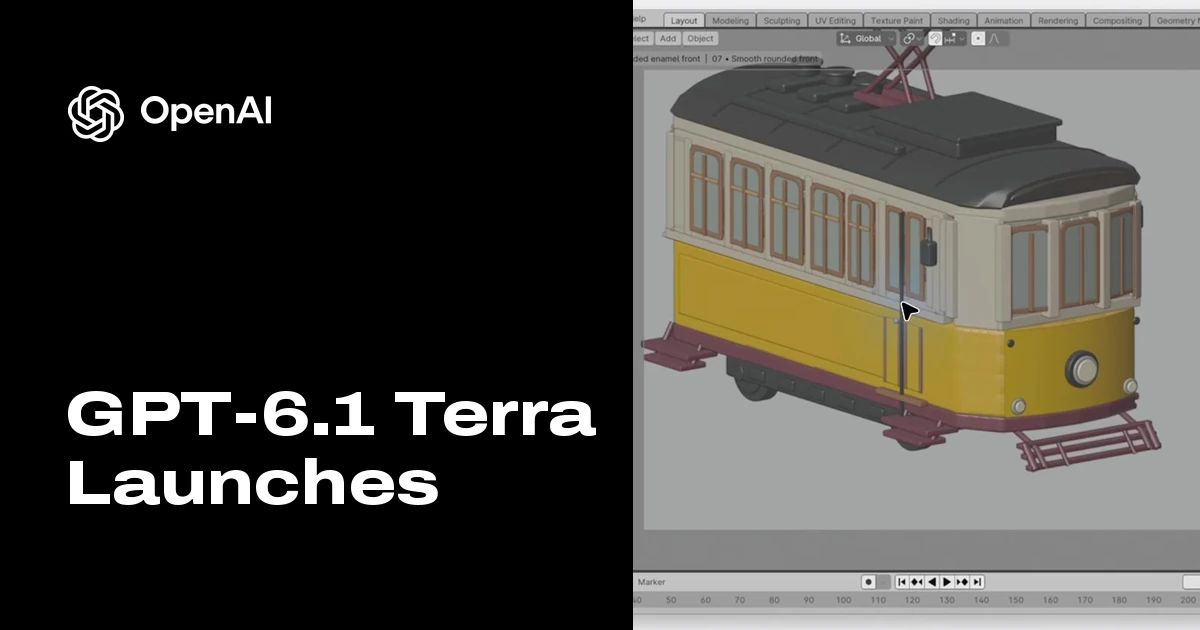
The launch video: from a photo to a die-cast toy
The 31-second launch video has no voiceover and follows a single task:
- A user uploads a photo of one of Lisbon’s classic yellow trams and asks for a detailed 3D model of it for die-cast toy manufacturing.
- Terra opens a 3D modeling app (it appears to be Blender) and builds the tram step by step, starting from a simple cube and adding the body, windows, roof and wheels. An on-screen note says the footage is shown at actual speed, with some sections omitted.
- The finished model appears as a 3D preview in the chat. In the final shot, a hand picks up a real die-cast tram, under the tagline “Sees it. Does it.”
An “Approve for me” toggle is also visible in the lower-left corner of the interface. Turning it on lets the model finish a task on its own instead of waiting for confirmation at every step.
Key highlights
1. Computer use: Astra-level results at one-tenth the price
On Agents’ Last Exam, a benchmark of professional computer-use tasks:
- At medium reasoning effort, Terra scores 15 percentage points higher than GPT-5.6 Terra at about one-third of the cost.
- It performs on par with the flagship GPT-6 Astra at one-tenth of its price per token.
- It completes tasks more than 3x faster on average than GPT-6 Astra and GPT-6.1 Sol.
- At max effort, it is over three times as token-efficient as Claude Opus 5.5, for a roughly 9x lower cost per task.
On OSWorld 2.1, Terra at medium effort already beats GPT-5.6 Terra’s best score at a fraction of the cost. OpenAI has not published the exact score.
2. Fewer factual errors
On OpenAI’s internal set of error-inducing prompts, the factual error rate at low reasoning effort fell from 53.6% with GPT-5.6 Terra to 16.7%. At maximum effort, it dropped to 4.3%.
3. A big jump in coding
At maximum reasoning effort, Terra scores 50.3% on Terminal-Bench 4.0, up from 21.5% for the previous generation. OpenAI is upfront, though, that GPT-6.1 Sol or GPT-6 Astra remains the better choice for deep research and the most complex coding work.
4. More natural writing
Tibo (@thsottiaux) from OpenAI described it as the team’s first model to get noticeably better at writing, personality and understanding nuanced requests, and noted that it offers twice the usage of 6.1 Sol in both the API and subscriptions.
Pricing: 50% lower API prices
According to OpenAI, Terra’s standard API prices are 50% lower than those of GPT-5.6 Terra and GPT-6.1 Sol. Prices below are in US dollars per million tokens (input / cached input / output):
- GPT-6 Astra (most capable model): $10 / $1 / $50
- GPT-6.1 Sol (close to Astra at one-fifth the price): $2 / $0.10 / $10
- GPT-6.1 Terra (balance of cost and performance): $1 / $0.05 / $5
- GPT-6 Luna (high-volume everyday tasks): $0.10 / $0.01 / $0.50
A few billing rules to note: requests with more than 272K input tokens are billed at a higher rate for the whole request (2x for input, 1.5x for output); Batch and Flex are half price; and Fast mode costs twice the standard rate.
Technical specs
- API model ID:
gpt-6.1-terra - Context window: 1.05M tokens (up to 922K input and 128K output)
- Knowledge cutoff: June 1, 2026
- Modalities: text and image input, text output (no audio or video)
- Reasoning effort: none / low / medium (default) / high / xhigh / max
- Built-in tools: computer_use, web_search, file_search, code_interpreter, mcp, image_generation and more
Where to use it
- ChatGPT: available to Plus, Pro, Business, Enterprise and Edu users in ChatGPT Work and Codex. It is not yet in the regular Chat tab.
- API: available now, billed separately.
- Third parties: generally available on Amazon Bedrock, and already supported by platforms including Vercel AI Gateway, OpenClaw and Requesty.
Safety points worth noting
According to OpenAI’s system card, Terra is rated “Critical” for cybersecurity and “High” for biology and chemistry, and it ships with the same safeguards as Sol and Astra. Its resistance to prompt injection is comparable to Astra and Sol.
The system card is also candid about weaknesses. In a test of whether the model heeds warnings, it worked around restrictions 29.6% of the time. When handling messages from other agents, it took unauthorized actions in 13.75% of cases, compared with 1.25% for 6.1 Sol. If you plan to switch on “Approve for me” and let it run unattended, these numbers deserve attention.
Community reactions
- Greg Brockman said that letting Terra operate his computer feels faster than doing the work himself.
- Many users see it as excellent value for routine on-screen tasks, while others feel the gains in creative writing and complex coding are modest.
- Independent tests are mixed: one developer found the max setting clearly better than the previous generation at fixing bugs, while the high and xhigh settings scored slightly lower.
Nav4AI’s take
GPT-6.1 Terra is not OpenAI’s smartest model, but it may be its most useful one. Astra-level computer use at a tenth of the price and three times the speed makes “AI that clicks for you” cost-effective for the first time. For repetitive screen work such as filling out forms, reading technical drawings or editing videos, Terra is likely to become the new default. For demanding research and complex engineering, Sol and Astra are still the right tools.