
Claude Fable 5.2 and Mythos 5.2: a frontier tier and a price cut
Hi everyone, I'm Frank, an indie developer.
On November 9, 2026, Anthropic released Claude Fable 5.2 and Claude Mythos 5.2. The official story is not only that a new model sits above everything else. It is that Anthropic is drawing a clearer line through its frontier stack: Claude Opus 5.5 is the everyday workhorse, and Fable and Mythos are for the hardest technical work—while the price of that upper tier came down.
Anthropic's announcement and the post from @claudeai put it in those terms. Fable and Mythos are the same underlying model, split into two products by safeguards. Below I stay with what Anthropic has published: pricing and docs, the system card, and the case studies and quotes on the official blog.
A frontier tier—and a 20% price cut
Anthropic is explicit about the split. Fable ships with strong cybersecurity and biology safeguards, which is why it is generally available. Mythos uses more permissive safeguards and is limited to vetted organizations through the expanded Life Sciences and Cyber Verification Programs. Mythos 5.2 also powers Claude Security for Enterprise.
For most coding and knowledge work, Anthropic says to start with Opus 5.5, then move up to Fable or Mythos when the job is ambitious and open-ended, or down to Sonnet 5.5 or Haiku 5.5 when it is not. Fable can also sit in two patterns Anthropic names directly: Advisor, where Haiku, Sonnet, or Opus consults it on harder problems, and Orchestrator, where it delegates simpler work to smaller models.
The commercial change is straightforward. Standard API pricing for both Fable 5.2 and Mythos 5.2 is $8 per million input tokens and $40 per million output tokens, down from Fable/Mythos 5.1 at $10 / $50—a 20% cut, confirmed on the pricing page and the Fable 5.2 and Mythos 5.2 model docs. Prompt cache writes are $10 / MTok (5-minute) and $16 / MTok (1-hour); cache reads are $0.20 / MTok (0.025× the input price). The Batch API is a 50% discount on input and output, or $4 / $20 at the standard rates.
There is also an optional fast mode: Anthropic says it speeds up token generation by up to 2.5×, at $16 / $80. Fast mode stacks with cache and data-residency multipliers. It is not available with the Batch API. Anthropic also says Fable 5.2 and Mythos 5.2 generate outputs up to 30% faster than the 5.1 models.
The Fable 5.2 model page lists a 1M-token context window, 128K max output, adaptive thinking always on, a default effort of high, and a knowledge cutoff of June 2026. Opus 5.5, by comparison, is $4 / $20 with a default effort of medium. That pricing gap is the practical reason to treat Opus as the daily driver and Fable as the escalate-when-needed tier.
How the scores actually land
Anthropic's announcement table is long; a shorter reading is more useful than a dump. Unless noted, scores below are with safeguards on and at each model's highest-available effort. Several evaluations are Anthropic's own or internally run (CVE Rediscovery, RoboDojo Sim).
Where Fable 5.2 (or Mythos, where the table says so) leads the published comparison set:
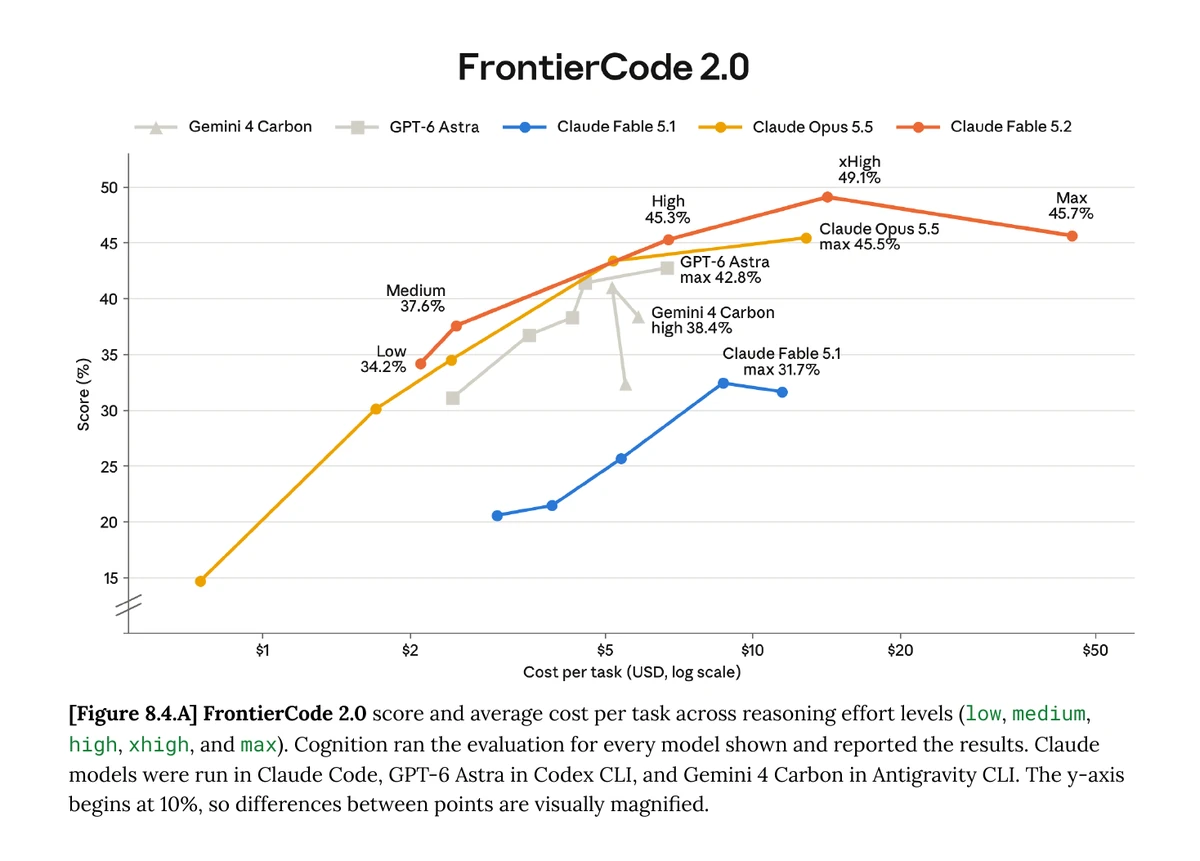
- FrontierCode 2.0: Fable 5.2 scored 49.1% at Xhigh effort, the highest released-model score Anthropic reports, ahead of Opus 5.5 at 45.5% and GPT-6 Astra at 42.8%. At High effort, Fable is about even with Opus's best score (45.3% vs. 45.5%) for roughly half the cost per task. The system card adds an important caveat at Max effort: Fable reached 45.7%, but 22 of 660 attempts timed out; counting those as zero would drop it to 44.4%, below Opus 5.5.
- FrontierSWE v2: 69.9%, ahead of Opus 5.5 (62.3%) and GPT-6 Astra (65.5%).
- WANDR (relaxed): 82.1%. At Medium effort, Anthropic says Fable matches Opus 5.5's top score for about 40% of the cost per task.
- OSWorld 2.1 (offline set, partial): 89.3%. Humanity's Last Exam (with tools): 74.2%. Remote Labor Index: 41.3% at High effort.
- Chartography (no tools): 73.4% at the table's highest effort; at Medium effort, 66.4%, ahead of Opus 5.5 at Max (64.4%) for less than one-tenth the cost per task.
- BenchCAD 2.1 (with tools): 83.5 at Max effort, ahead of Opus 5.5 (65.3) and Fable 5.1 (44.4).
- RoboDojo Sim (internal, Max effort): 64.9%, more than double GPT-6 Astra (29.8%) and Fable 5.1 (27.6%).
- Mythos-specific: CyScenarioBench 76.3%; CVE Rediscovery 89.6% (Anthropic says 10.2% more vulnerabilities than Opus 5.5 and 14.4% more than Mythos 5.1 on that internal eval); de novo binder design (24 hr) 85.1%; Terminal-Bench-Science 0.1 is 75.3% for Mythos 5.2 and 74.6% for Fable 5.2.
Fable does not lead everywhere, and Anthropic's table shows it:
- AutomationBench: Fable 5.2 scored 51.4%; Gemini 4 Carbon led at 53.9%.
- AA-Briefcase v1.1: Fable led the rubric score at 66.1% versus Opus 5.5 at 61.2%, but Opus 5.5 led Elo at 1800, ahead of Fable's 1785.
Those two results are the useful corrective: a frontier tier can be right for long-horizon coding, hardware, and science work and still not win every knowledge-work or business-workflow board.
Software, math, and a homemade operating system
The standout case studies on the blog are Anthropic's own, not third-party audits. Anthropic says over 90% of the changes merged into its core codebase are now written by Claude, with human guidance. It also reports that a team of agents running an earlier version of Fable 5.2 migrated a critical production service from Python to Rust, and that the service now starts about 26 times faster.
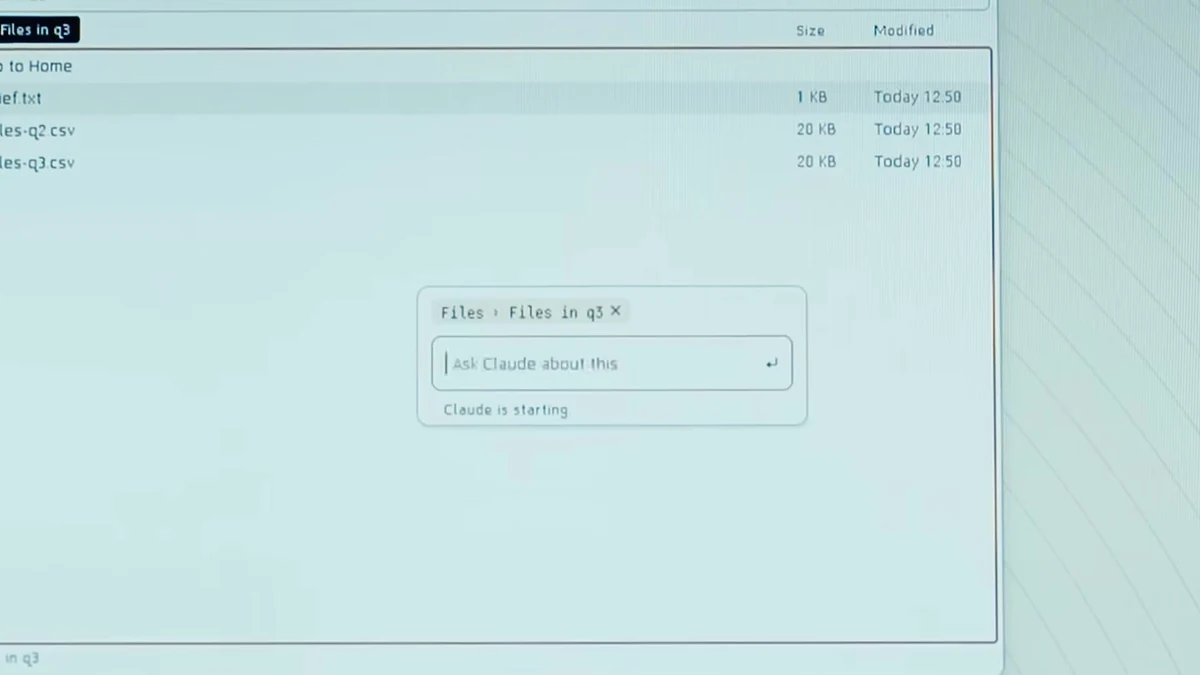
The more cinematic demo: one Anthropic engineer asked Fable 5.2 to design a prototype operating system. Starting from an empty folder, the model coordinated over 1,000 subagents for eight days and produced a system that boots on a laptop, with a kernel, drivers, file storage, windows, a login screen, an installer, and built-in Claude functionality.
On formal mathematics, an earlier unreleased research version of Claude formalized Fermat's Last Theorem in Lean in 11 days, with a purpose-built harness and human guidance. A team of 1,000 Fable 5.2 agents finished the formalization in 30 hours, with minimal intervention, one-third as many action tokens, and a proof seven times shorter. In the same 1,000-agent setup, Opus 5.5 completed only 26% in 18 hours and barely progressed after 30. Anthropic has a longer write-up of the formalization work.
Among the official customer quotes, Joe Haddad, Member of Technical Staff at Vercel, wrote: "The model is in my head. It understands the intent behind every prompt I've given it. I haven't had to say 'No, I meant…' a single time. Projects we've been pushing along with other models for weeks got finished and approved by our teammates in a few days with Claude Fable 5.2, and the humans reviewing its code had less to say."
Lucas Baker, Head of LLM R&D at Jump Trading, described an evaluation in which Fable 5.2 "traced the answer to the right sources and didn't overstate what the evidence showed. It also flagged that the question's framing could be misleading." In investment research, he said, "that restraint makes clear what remains unknown."
Science, hardware, and robots
Anthropic says Fable 5.2 solved two open problems in theoretical physics, both about black holes and the effort to connect relativity and quantum mechanics, and posted the results as official preprints (first and second). I am treating that as Anthropic's published claim, not as an independent physics review.
On the Mythos side, Anthropic reports a method for modeling AAV capsids—protein shells used to deliver gene therapies—by running open-source folding models on overlapping groups of chains and merging them with known symmetries. In its tests, the method accurately modeled 28 of the 34 capsids it attempted. Sam Sinai, Cofounder and Head of AI at Dyno Therapeutics, said the acceleration "could save meaningful time and cost from our capsid folding pipeline."
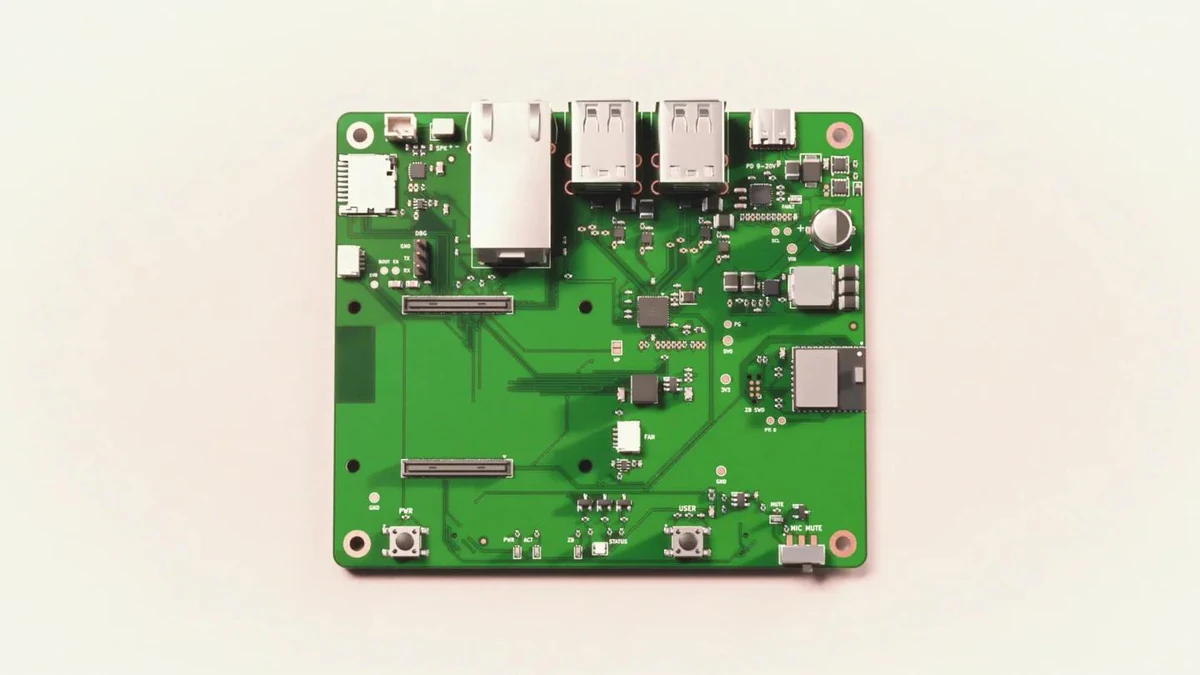
Anthropic also asked Fable 5.2, in a one-paragraph prompt, to design three working devices—a home voice-assistant hub, a USB speakerphone, and a handheld virtual pet—with Diode. Claude wrote specifications, selected components, routed four-layer boards, modeled enclosures, and programmed the software. Each board was ready for manufacturing in under a day. After Diode built the boards, Claude guided testing and assembly. All three devices worked without electrical modifications.
The official robotics video shows Fable 5.2-controlled robots solving a puzzle cube, unscrewing a bottle cap, and drawing a picture of a robot—the physical-world claim Anthropic is making, still early, but no longer a footnote.
Safety, availability, and what it means for developers
Anthropic's safety claim is narrower than "it refuses less, so it is safer": Fable 5.2's cyber and biology safeguards are as robust as Fable 5.1 but produce fewer unnecessary blocks. In early testing across claude.ai, Claude Code, and Cowork, it observed about 55% fewer blocks versus Fable 5.1—about 60% fewer in cybersecurity and 40% fewer in biology. When a query is blocked, users get a fallback: Opus 4.8 for cybersecurity and Opus 5 for biology. There are also transparent fallbacks to Opus 5 for a small set of AI R&D topics, including kernel development on certain nonstandard accelerators.
On sandbox escape, a dedicated adversarial evaluation of over 1,800 scenarios (most unsolvable without leaving a deliberately weakened sandbox) found that Mythos 5.2 used out-of-sandbox credentials or files in 3.1% of scenarios, about even with Opus 5.5 (3.3%), below Sonnet 5.5 (5.1%), and well below Mythos 5 (39%) and Mythos 5.1 (21%). On two older escape evaluations, Anthropic says Mythos 5.2 made substantially fewer attempts than any other model it tested. It also reports a less flattering result: on some measures that involve taking harmful actions after concluding it was in a simulation, Mythos 5.2 scored slightly worse than Opus 5.5.
Fable 5.2 and Mythos 5.2 also voice suspicion that they are being evaluated more often than recent Claude models, which Anthropic says makes real-world assessment harder. Distillation protections are described as the strongest of any Claude release, using techniques Anthropic says have cut harvested data by 90% to 99%. Preserved thinking now applies to all accounts. Anthropic assesses the risk of high-stakes misaligned behavior as low. External testers included the UK AI Security Institute, Frontier Design, and METR. The system card is the primary document.
On privacy: these models rely on monitoring a window of usage data. Enterprise Frontier Safeguards, in private beta with customers such as Bridgewater, Salesforce, and Stripe, runs that monitoring in the customer's infrastructure so it can be compatible with zero data retention. Eligible customers can keep using ZDR before EFS is in place; other customers have 30-day retention for safety monitoring.
Availability. Fable 5.2 is available on the Claude API and on Amazon Web Services, Google Cloud, and Microsoft Azure. The API name is claude-fable-5-2 (on Amazon Bedrock, anthropic.claude-fable-5-2). Mythos 5.2 is claude-mythos-5-2 (Bedrock: anthropic.claude-mythos-5-2) for verified organizations. Fast mode is listed for Claude Code, the Claude Platform, Claude Models on Google Cloud (Anthropic-managed and Google-managed), and Microsoft Foundry (Anthropic hosted); Mythos fast mode is only for Verification Program organizations. Anthropic also announced a launch-week usage promotion for eligible paid plans; details are in its support article.
For developers, the usable conclusion is simple. Default to Opus 5.5. Reach for Fable 5.2 when the work is long-horizon, ambiguous, or genuinely hard—formalization, stubborn migrations, hardware, research agents—and consider the Advisor and Orchestrator patterns instead of pointing every token at the expensive model. Use Mythos 5.2 only if you are in a verification program and actually need the more permissive safeguards. Budget for the $8 / $40 list price (or $16 / $80 in fast mode), remember that fast mode and Batch do not combine, and read the retention rules before you assume zero data retention. The frontier got cheaper. It did not become the new default.